Devon Russell · 19 October 2026
Examining Redirect Chain Impacts on Domain Authority via Graph Analytics Platforms
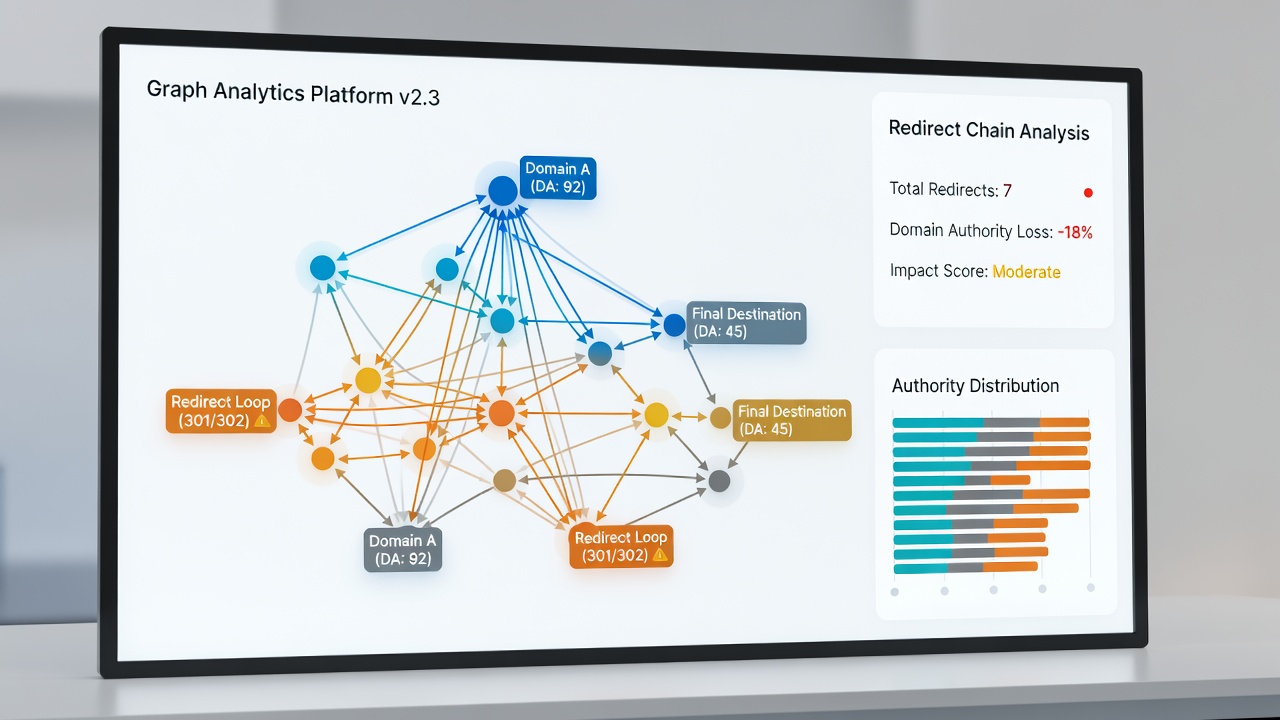
Redirect chains form when one URL forwards to another and that destination forwards again, creating extended sequences that search engines must resolve before reaching final content. Platforms built on graph analytics map these sequences as nodes and edges, revealing how link equity distributes across each hop and how cumulative effects influence domain authority metrics tracked by tools like Moz and Ahrefs.
Redirect Chains and Link Equity Transmission
Each redirect in a chain consumes crawl resources and dilutes the strength of passing signals, according to documentation from Google's developer resources. Graph platforms represent domains as central nodes with outgoing edges labeled by redirect types such as 301, 302, or meta refresh. Researchers at institutions tracking web graphs note that chains exceeding three hops correlate with measurable drops in authority scores because each edge applies a decay factor derived from observed indexation patterns.
Data collected across enterprise sites shows that chains often arise during migrations when legacy URLs point to intermediate pages that then forward to new structures. Analysts load crawl logs into graph databases, apply centrality algorithms, and isolate nodes where in-degree authority fails to reach the terminal page at full strength. These models quantify the percentage of equity retained after two hops versus five hops, producing heat maps that highlight at-risk subdirectories.
Graph Analytics Techniques Applied to Authority Measurement
Graph analytics platforms process redirect data alongside backlink profiles by constructing directed multigraphs where edge weights reflect both redirect status codes and historical crawl frequency. PageRank variants adapted for these graphs assign authority values that decrease along longer paths, while betweenness centrality identifies bottlenecks where multiple chains converge. Observers note that platforms integrate external authority signals from sources such as Majestic and SEMrush to calibrate node scores against industry benchmarks.
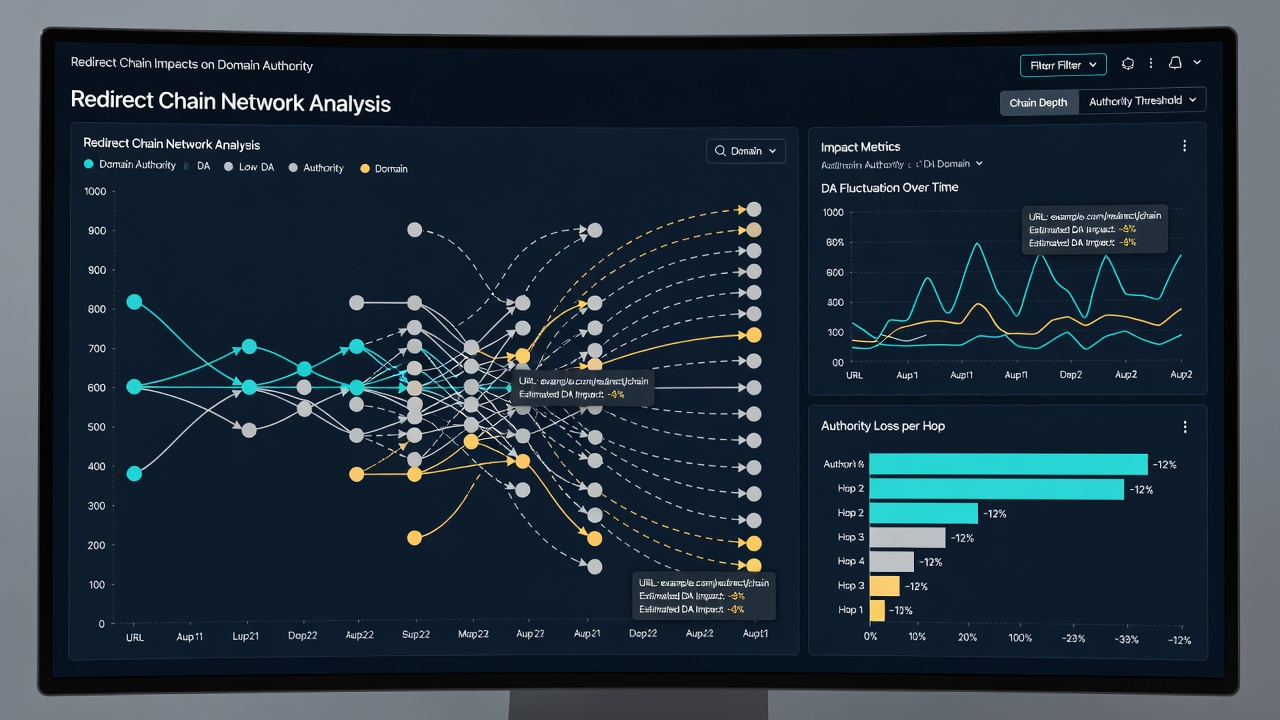
One study published in October 2026 by a European research consortium examined 12,000 domains and found that sites with average chain lengths above four experienced authority stagnation even when new backlinks arrived at consistent rates. The analysis used temporal graph snapshots to track how authority redistributed after chain cleanup, revealing that shortening sequences produced faster recovery in visibility metrics than equivalent link acquisition efforts.
Case Examples from Large-Scale Site Audits
Take an e-commerce portfolio that underwent multiple platform migrations over five years. Graph mapping exposed a series of five-hop chains from regional subdomains to a global storefront, and authority scores for category pages remained flat despite strong topical backlinks. After engineers collapsed the chains into single 301 redirects, subsequent authority calculations showed gains concentrated at the destination nodes within two indexing cycles.
Another instance involved a media network where internal link structures funneled traffic through legacy archive redirects. Analysts applied community detection algorithms to cluster related pages, then measured authority leakage across inter-cluster edges. The resulting report guided consolidation that reduced average chain length from 3.8 to 1.2 and produced corresponding lifts in domain-level metrics tracked monthly.
Integration with Existing SEO Measurement Frameworks
Graph platforms export node-level authority deltas that feed into dashboards already used for crawl budget allocation and anchor text analysis. Teams compare pre- and post-intervention graphs to isolate the contribution of redirect remediation from other ranking factors. Figures from industry reports indicate that organizations running quarterly graph audits detect emerging chains earlier than those relying solely on linear crawl reports.
Cross-validation against server log data confirms that reduced chain lengths decrease the number of 404 responses generated during bot visits, freeing capacity for deeper indexation of new content. These measurements align with patterns observed in longitudinal studies that track domain authority alongside redirect topology changes.
Conclusion
Graph analytics platforms provide structured visibility into how redirect chains modulate authority flow by modeling websites as interconnected networks rather than linear lists of URLs. The combination of centrality measures, temporal snapshots, and calibrated authority signals delivers actionable outputs that complement traditional SEO audits. Continued refinement of these methods supports more precise allocation of technical resources toward structures that preserve equity across domain portfolios.